

Have you ever wondered how an old document can still affect our daily lives? Constitutional law shows us that the rules of our country were born from tough debates and important deals made way back in 1787. It works like a blueprint, giving our government a clear plan while protecting our personal freedoms. When today's judges look at its words, they see a guide that helps keep power balanced and defends individual rights. This discussion looks at how constitutional law not only supports our legal system but also upholds the traditions that help our country run smoothly.
Constitutional Law: Empowering Key Legal Traditions
Constitutional law is a set of basic rules that guide how our country is run. It all began back in 1787 when a group of people met in Philadelphia to draw up these rules. The plan was put into action in 1788, but not without some rough debates that almost stopped it from happening. This shows us just how important compromise was in creating these rules.
The Constitution starts with an inspirational introduction, known as the Preamble. It then unfolds into seven clear sections that set up our government’s three main branches: the lawmakers, the president and the team running the country, and the courts that interpret the laws. These parts make sure that power is split up fairly and used wisely.
Later on, in 1791, the first ten changes to the Constitution became known as the Bill of Rights. These changes protect everyday freedoms like speaking your mind, choosing your religion, and gathering with others. The Bill of Rights reminds us that personal liberties are a priority in our system of government.
The Constitution also decides how power is shared between the national government and the states. It acts like a guidebook for settling disagreements and making sure the government stays within its limits. Even today, judges study these important words carefully (recentlegalnews.com?p=4980) to solve modern issues. Imagine it like following a simple recipe: you gather the main rules (the Articles and Amendments), mix them with fair oversight, and create a legal foundation that continues to support every part of American life.
Historical Origins and Evolution of Constitutional Law

Before the United States had its current Constitution, the central government was too weak to keep up with a growing nation. Between 1781 and 1789, the Articles of Confederation didn't allow the government to collect taxes or enforce laws, which made life really tough. This weakness led leaders to call for the 1787 Constitutional Convention, where discussions took on a friendly yet serious tone.
At the convention, people split into two groups. On one side were the Federalists, who believed that a strong central authority was essential for keeping the country together. On the other side were the Anti-Federalists, who worried that too much power in one place would take away the rights of individual states. These lively debates helped set up a framework that respects both national unity and the power of the states.
Important ideas and documents also played a big role in shaping these early laws. For example, the Magna Carta from 1215 showed that even kings had limits to their power. And thinkers like John Locke and Montesquieu, who explained natural rights and the idea of keeping powers separate, influenced the founders greatly. It’s interesting to think that the framers looked back over seven centuries of ideas, from medieval England to revolutionary France, to build a government that protects individual freedoms while staying strong.
After the Constitution was approved by nine states in 1788, it continued to grow and change. Landmark amendments passed after the Civil War, the 13th, 14th, and 15th Amendments between 1865 and 1870, worked to expand rights and redefine what it means to be an American citizen. In this way, constitutional law has kept evolving, ensuring that its core ideas continue to protect personal freedoms and contribute to a stable nation.
Core Principles: Separation of Powers and Checks and Balances in Constitutional Law
The U.S. Constitution splits power among three branches so that no single group can take over. Article I sets up Congress to make the laws. Article II creates the Presidency to carry out the laws. And Article III forms the Judiciary to explain what the laws mean. This design is like a built-in safety feature that helps keep things fair.
Each branch also has a little control over the others. For instance, Congress can override a presidential veto, which means the President can’t simply do whatever he wants after signing a law. The Senate helps by approving or rejecting the President’s choices for important jobs. In court, judges use something called judicial review, a way to check if the branches are following the Constitution (think of it like a referee making sure everyone plays by the rules). This idea, first seen in the famous Marbury v. Madison case from 1803, stops any one branch from misusing its power. Montesquieu, a key thinker on this, believed that dividing power was the only way to keep our government fair and steady.
When judges later interpret laws, they stick to these limits, continually working to keep our system balanced.
Landmark Supreme Court Cases in Constitutional Law

The Supreme Court stands as our nation’s top legal referee, and over time its decisions have reshaped how we see our Constitution. In the early case of Marbury v. Madison from 1803, the court set the groundwork for what we now call judicial review. This meant that if a law doesn’t match the Constitution, the court can cancel it, kind of like a referee blowing the whistle when a play goes off rule.
Then there’s McCulloch v. Maryland from 1819, which boosted federal power. The court basically said that even if a power isn’t clearly written down, it can still be part of Congress’s role. Think of it as finding a special ingredient in a recipe that makes the whole dish work better.
The case of Brown v. Board of Education in 1954 changed the game by ruling that keeping students apart by race in public schools was unfair. This decision showed that separate isn’t always equal, much like opening a door that had been shut for too long. It was a clear stand against injustice and helped move the country toward equality.
Roe v. Wade in 1973 was another major moment, protecting personal privacy by saying that some decisions about life should be free from government control. Imagine having a private room where you can decide your own path without interference, that’s what this ruling aimed to create.
United States v. Lopez in 1995 checked the reach of federal power by drawing clear limits on what Congress can control. It was a reminder that not every issue falls under federal watch, affirming that sometimes local rules matter most.
And in Obergefell v. Hodges in 2015, the court made it clear that same-sex marriage is a right protected by the Equal Protection Clause. This ruling shows that as times change, the court keeps updating our rights to reflect fairness and equality in everyday life.
Constitutional Amendments Overview and Fundamental Rights Framework
This summary looks at some key changes in our Constitution that protect our everyday freedoms. These amendments help set up the rules so everyone can enjoy rights that matter.
Below is a reference table that shows a few important amendments along with the year they were made and the main right they protect:
| Amendment | Year | Key Right |
|---|---|---|
| 1st | 1791 | Right to free speech, religion, press, assembly, and petition |
| 13th | 1865 | Ended slavery |
| 14th | 1868 | Guarantees fair treatment and equal protection under the law |
| 19th | 1920 | Gave women the right to vote |
| 26th | 1971 | Lowered the voting age to 18 |
Each amendment marks a clear step forward in our country’s quest for fairness. The First Amendment set the stage by protecting free expression and the right to share ideas openly. Then, the 13th Amendment brought an end to slavery, and the 14th made sure that everyone is treated fairly by the law. Later on, the 19th Amendment empowered women with the vote, and the 26th allowed younger citizens to join in by lowering the voting age.
Together, these changes form the core of our legal traditions. They still shape our society today by ensuring that every citizen can enjoy the freedoms our nation was built on.
Judicial Review and Decision-Making Processes in Constitutional Law
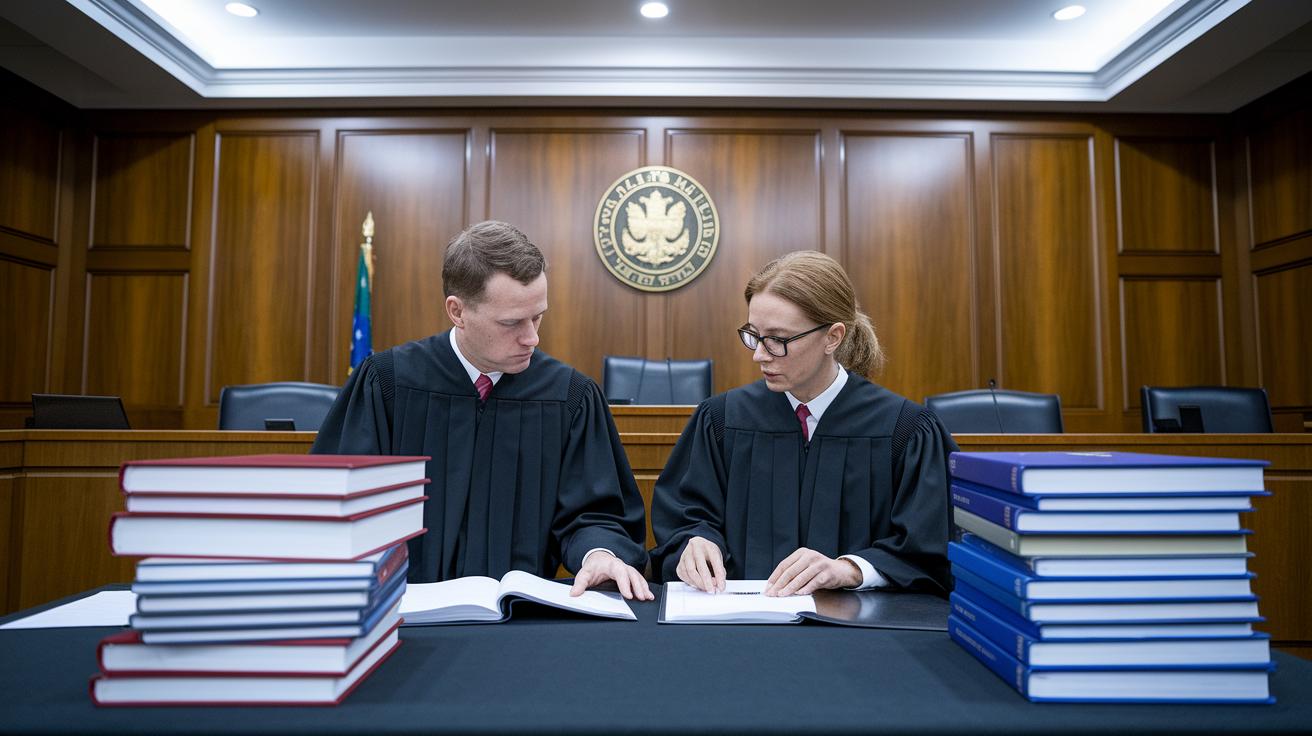
Marbury v. Madison, decided in 1803, started the idea of judicial review in the United States. This means that courts have the power to cancel laws that stray from the Constitution. That ruling has guided judges ever since, helping them keep a close watch on government power.
It all kicks off with a petition. Cases then move into what’s called the cert pool, leading to a meeting among judges who decide if the issues should be looked at further. Think of it like a careful pick: only the most critical topics get a chance to reshape how laws are understood. Even a simple petition can spark a lively debate that changes long-held legal views.
When dealing with constitutional questions, judges use a few different methods. Originalism means sticking to the text’s original meaning. Textualism focuses closely on the actual words written down. And then there’s the living-constitution approach, where the document is seen as a guide that grows and changes over time. Judges also use tests like strict scrutiny (very close examination), intermediate scrutiny, and rational basis review to decide on cases. These tools help set important rules in later decisions.
Together, these approaches form a balanced legal system that applies constitutional rules fairly and protects our rights every day.
Federalism in Constitutional Law: Balancing Federal and State Powers
Federalism in the United States is built on two main ideas. First, the Supremacy Clause in Article VI tells us that federal law comes before state laws. Next, the Tenth Amendment makes it clear that any power not given to the national government stays with the states. This setup helps balance national power with local control.
Sometimes these borders get a bit blurry. For instance, the 1995 United States v. Lopez case showed that federal power has its limits when it comes to local business matters. Even now, debates over the Affordable Care Act make people wonder how much say the federal government should have in healthcare. And when states allow cannabis, it sparks questions about who really gets to set the rules.
Federalism is not a static idea, it changes with new challenges. Think of it like building a layered cake: federal laws are the sturdy base, while states add their own special flavors on top. Each court ruling and policy discussion fine-tunes this balance, mixing old Constitutional principles with fresh, practical solutions. In the end, this shape of federalism touches our daily lives and shows why the nation and the states need to work together.
Modern Challenges and Debates in Constitutional Law

Today, constitutional questions spark lively talks about our rights and how much power the government should have. Take digital privacy, for instance. The way we follow the Fourth Amendment is changing as information zips quickly from one device to another. It makes you wonder if old rules can really cover our modern lives. If you're curious, check out interpreting digital privacy law headline updates for more details.
Executive orders also stir up controversy. Many people are worried that these orders might blur the clear lines between different branches of government. In courtrooms, discussions are heating up about whether judges should stick strictly to written rules or adjust them to meet new social needs. It’s a debate that makes you think about the balance of power and its effect on everyday life.
Other evolving topics include setting rules for artificial intelligence and creating fair election laws for online participation. These issues push us to reexamine how we protect our rights, and where government authority should end. In many ways, this is like piecing together a puzzle, where every decision has a real impact on our lives.
Final Words
In the action, this article broke down constitutional law fundamentals, exploring the foundation set by the U.S. Constitution and how its key documents shape American governance. It touched on historical origins, core principles, landmark court rulings, and modern challenges. Each section helped clarify how the system works and why it matters to our everyday lives. The discussion on constitutional law leaves us with hope and excitement for how legal thought can guide fair decisions and strengthen our communities.
FAQ
Frequently Asked Questions
- What does a constitutional lawyer do?
- The constitutional lawyer advises on legal challenges involving government structure, individual rights, and constitutional interpretation, handling cases that affect how power is divided and rights are protected.
<dt>Where can I find constitutional law PDFs?</dt>
<dd>The constitutional law PDF refers to digital files that explain core principles of the Constitution, available from academic libraries, reputable legal websites, and online legal resource platforms.</dd>

<dt>What are some constitutional law examples?</dt>
<dd>The constitutional law examples include landmark cases like Marbury v. Madison and McCulloch v. Maryland, as well as the framework of the Bill of Rights that safeguards key individual freedoms.</dd>

<dt>What is a constitutional law book?</dt>
<dd>The constitutional law book is a resource that explains the U.S. Constitution's framework, key cases, and principles, serving as a study tool for students and a reference for legal professionals.</dd>

<dt>What is a simple definition of constitutional law?</dt>
<dd>The simple definition of constitutional law is a set of core legal principles in the Constitution that allocates powers among government branches and secures individual rights through established rules and amendments.</dd>

<dt>What are the first 10 laws of the Constitution?</dt>
<dd>The first 10 laws of the Constitution refer to the Bill of Rights, the initial amendments that outline essential freedoms such as speech, religion, and fair treatment under the law.</dd>

<dt>What is the constitutional law of the United States?</dt>
<dd>The constitutional law of the United States comprises the Constitution and its amendments, forming the legal foundation that structures government, allocates power, and protects citizens' rights.</dd>

<dt>How can I pursue a constitutional law class, degree, or career?</dt>
<dd>The path to a constitutional law class, degree, or job involves studying legal fundamentals through coursework, earning a law degree, and exploring careers in government, research, or legal advocacy centered on constitutional matters.</dd>